What a glass trade supplier should actually give you
Anyone can sell you a pane of glass. This page is about the things that separate a glass trade supplier you can build a business on from one that quietly costs you money every month.
Glass is the easy part of what a glass trade supplier does
A glass trade supplier has to get four things right before the glass itself matters: the same product twice, a lead time that holds, a technical answer when you ask for one, and a clear position when a piece comes back wrong. Get those right and the square metre rate is almost a detail. Get them wrong and no rate saves you, because the money you lose is in labour, return visits and jobs that slide past a handover date.
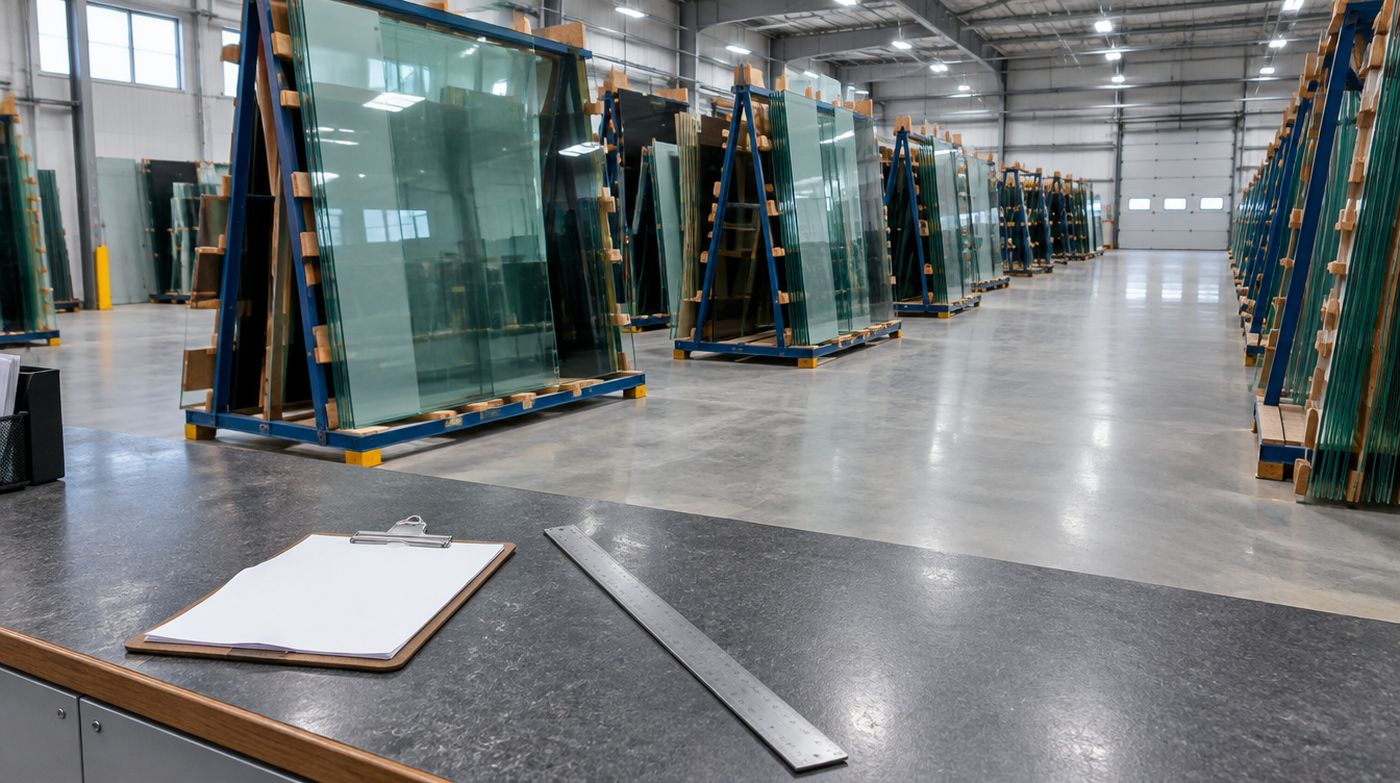
We cut, edge, polish, drill, toughen, laminate and make up sealed units at our own workshop at 6 Atlas Road in Wembley. That matters less as a boast than as a fact about accountability. When your list is queried or your delivery is late, the person who takes the call is in the same building as the cutting table and the furnace, and there is nobody further up a chain to blame.
The rest of this page is about how you find that out before you commit, because every supplier says the same things on a website. Including us. You should be testing the claim rather than reading it.
Consistency is the part you only notice when it disappears
Float glass is a commodity and it is tempting to treat it as interchangeable. On clear 4mm sitting inside a frame, mostly it is. The moment you are matching something, it stops being true. Clear float carries a green cast that strengthens with thickness, and the exact tone varies between production runs. Glaze four shelves from one batch and the fifth from another six weeks later and somebody with a good eye will see it. On low iron, mirror and anything that will be backlit or backpainted, the variation shows up sooner.
The same is true of processing. A polished edge is a finish, not a specification, and two workshops will hand you two different looks from the same words. Arrised, flat ground and bright polished each mean something definite, but within each one there is a house style set by the wheels, the water and the operator. If you specify once and the next batch comes back glossier or duller, the finish is not wrong. It is just somebody else’s.
So when you test a supplier, order the same thing twice a few weeks apart and look at the two pieces side by side. One order tells you they can cut glass. Two orders tell you whether they are controlled.
How to test a glass trade supplier before you depend on them
Do not move everything across in one go. Run a new glass trade supplier alongside your existing one for a couple of months, on work that is real but not critical, and then decide. A trial order that is deliberately easy teaches you nothing, because every processor in London can cut six clear rectangles. Put some grit in it.
A useful trial list has one awkward piece. A shape with a radius corner, a pane with two holes near an edge, a long thin piece that will test their handling, or a mirror with a polished edge on one side only. You are not trying to catch anyone out. You are finding out whether they ask you the right question before they cut, which is the single best predictor of how the relationship will go. A supplier who cuts an ambiguous list without ringing you is a supplier who will one day cut thirty of them.
Then ring with a technical question you already know the answer to. Ask whether a toughened pane can be bevelled after the furnace. Ask what edge clearance a hole needs. Ask whether they would laminate two leaves for an overhead application and what interlayer they would use. The answer matters less than whether you got an answer at all, or a promise that somebody would call you back that nobody kept.
- Who does the toughening, and is the furnace in the same building as the saw?
- What is your working tolerance on a cut size, and do you hold it or the standard?
- What happens when a pane is wrong on your measurement, and what happens when it is wrong on mine?
- How is the order labelled, and will the labels match my list line for line?
- If I need one extra pane on Thursday afternoon, what actually happens?
- Which of these operations do you send out, and where does it go?
Lead times: ask what happens when one goes wrong
Every supplier quotes lead times that work when nothing goes wrong. The useful question is what happens when something does. A furnace goes down. A stock sheet comes off the rack with a scratch across the middle of it. A laminating run has to be scrapped. None of that is unusual and none of it is a scandal. What separates suppliers is whether you find out three days before or on the morning you were expecting the glass.
Ask it directly. If my order is going to be late, when will I know, and who rings whom. A supplier who says you get a call the moment they know is offering you something worth more than a day off the quoted time, because a late delivery you knew about on Monday is a scheduling problem and a late delivery you discover on site is two men standing about and a client to apologise to.
We would rather give you a day we can hold than the day you want to hear. If three suppliers are telling you what you want to hear and one is giving you a longer answer with a reason attached, the longer answer is usually the honest one. Price that in before you treat it as a mark against them.
What a remake policy tells you long before you need it
Everyone has a position on remakes. Very few will tell you what it is until there is broken glass on the floor and an argument to be had, which is the worst possible moment to find out. Ask on day one, while nothing is at stake, and listen to how specific the answer is.
A clear answer sounds like a division of responsibility rather than a sentiment. Our measurement, our cost. Your measurement, your cost, and we will cut it again as fast as we can get it on the table. Damage found before you sign, ours. Damage found a week later after the pane has stood against a wall on site, yours. That is not generous and it is not meant to be. It is unambiguous, which is what you need when you are pricing risk into a job.
Be wary of two kinds of answer. The vague reassurance that it will all be fine, because it will not feel fine at two o’clock on a Friday. And the policy that puts every risk on you regardless of whose error it was, because that supplier has decided in advance that nothing is ever their fault, and you will meet that decision eventually.
When we tell people to buy somewhere else
A trade supplier that wants every job is not being helpful. There is work we are the wrong call for, and saying so early costs us one order and saves you a bad month.
High volume runs of a single simple size, where the whole job is price per square metre and nothing else, usually sit better with a large regional processor who can put them through on one setup. Fire rated glazing, specialist structural interlayers and anything needing a printed or ceramic fired finish belong with specialists in those products. If an architect has named a particular coated glass, the honest answer is sometimes that getting that exact coating in takes longer than your programme allows, and you should be told that rather than quietly offered a substitute.
Where we are worth having is mixed lists with processing in them, awkward single pieces, short notice replacements, and orders where somebody needs to look at the drawing and think before anything is cut. If that describes most of your week, test us. If it describes none of it, we are probably not the right fit and there is no point either of us pretending otherwise.
Changing supplier without putting a live job at risk
Once you have decided, move in stages. Keep the old account open and warm for a couple of months, because the day you need an emergency obscure pane is the day the new supplier’s van is already out. Put your repeat work across first, since that is where consistency shows up fastest. Leave one-off specials where they are until you have watched the new supplier handle two or three without a query.
Then give them what they need to do well. A glass trade supplier who gets a clear list, a realistic date and a phone call the moment something changes will produce better work than one being managed by email at eleven at night. That part is on you, and it makes more difference to the result than most buyers expect.
FAQ
Questions about glass trade supplier
What are the warning signs of a bad glass trade supplier?
Four show up early. A list cut without a query when the list was ambiguous, because that means nobody looked at it. A technical question that comes back as a promise to call you back and then does not. Vagueness about remakes, since a supplier with a clear position states it plainly. And an edge finish or a tint that shifts between orders of the same specification, which tells you the process is not controlled. None of these appear on a first easy order, which is why a trial should include one awkward piece and be repeated a few weeks later.
What should I send when I ask a glass trade supplier for a price?
Everything needed to cut without a phone call. Product and thickness, finished sizes with the convention you are using, quantity, edge finish on each edge that matters, any holes, notches or radius corners with positions from a stated datum, whether the glass is toughened or annealed and why, and where it is going. The last point matters more than people expect, because a pane in a door or low in a partition changes what is legally acceptable. Add the date you need it and whether you are collecting. A list with those details gets priced accurately first time.
Is it worth using more than one glass trade supplier?
For most busy firms, yes. Two accounts cost nothing to hold and protect you on the day one supplier has a furnace down or a van off the road. Give one the bulk of the repeat work so the rate reflects real volume, and keep the second active with enough orders that you are a known name rather than a cold caller. What does not work is splitting every job across both to chase a few pounds, because you lose the consistency of a single processor and neither supplier learns how you work.
Send a cutting list or open an account
Lists quoted the same working day. Tell us the glass, the sizes and the processing and we will come back with a price and a lead time.