Glass processing in London: what each operation does and when it has to happen
Glass processing in London runs in a fixed sequence, and most expensive mistakes on an order come from asking for something after the point where it was still possible. This page sets out the operations and the order they have to happen in.
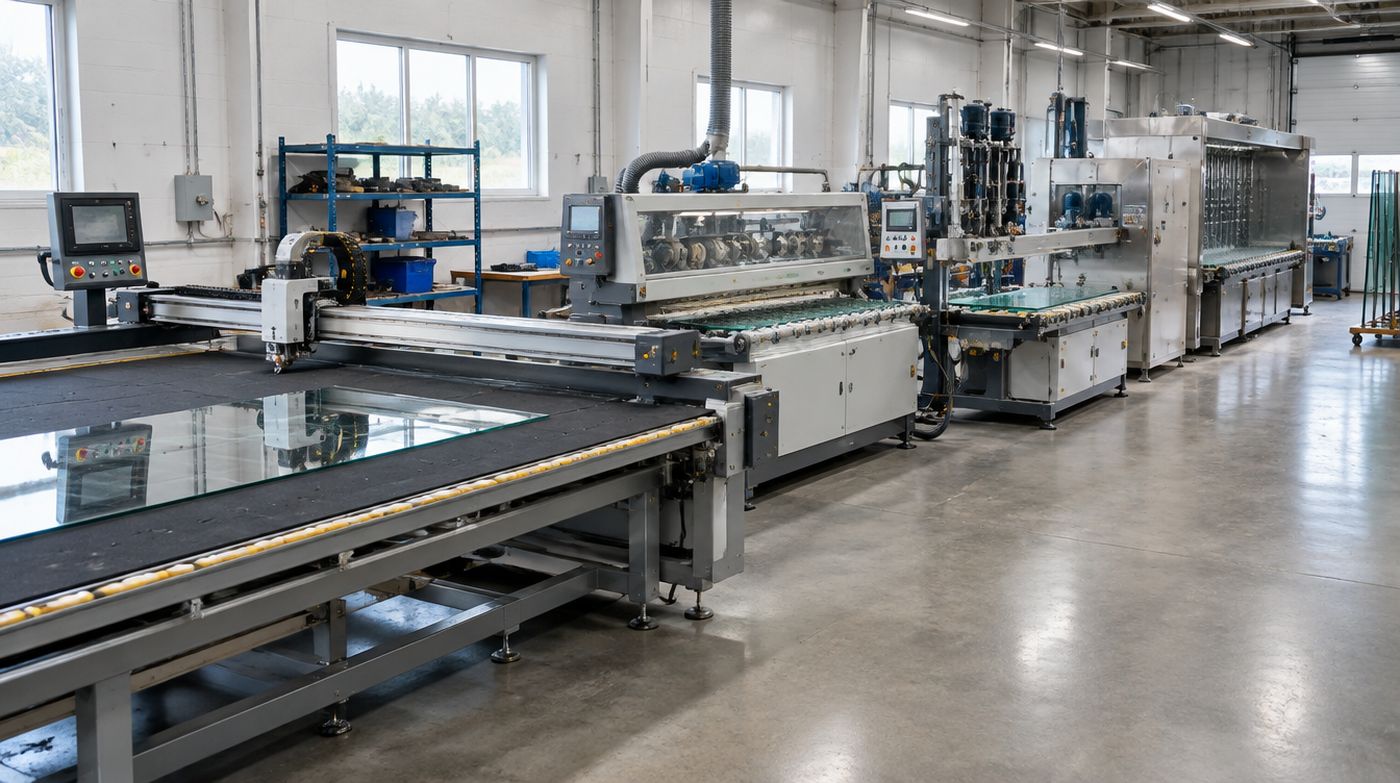
The one rule that governs every glass processing order
Nothing can be done to toughened glass. That is the rule, and understanding why it holds will save you more money than anything else on this page. Toughening puts the surfaces of a pane into compression and the core into tension, and the pane stays in one piece because those forces are balanced against each other. Cut it, drill it, grind it or even nick an edge and the balance fails, instantly and completely, and what you had becomes a heap of small fragments on the floor.
So every operation that changes the shape of the glass has to happen before the furnace. Sizes, holes, notches, cut outs, radius corners and the edge finish are all settled at the start. A toughened pane is a finished product, not a blank you can adjust later. Anyone offering glass processing in London who agrees to drill a toughened pane for you is either going to anneal it first, in which case it is no longer safety glass, or going to break it.
Glass processing in London, operation by operation
Cutting and sizing
A cutting wheel scores the surface and the glass is broken along the score. Straight cuts come off a table, shapes off a computer controlled machine or from a template. The important point for a buyer is that a cut size is a nominal size with a tolerance band around it, so a pane is never exactly the number on your list. That is why you allow clearance in a frame rather than measuring the aperture and ordering it.
Arrissing
The sharp corner left by the cut is taken off with a narrow bevel along the edge, usually a few tenths of a millimetre. It is a handling and safety treatment rather than a finish, it is required before anything goes into a furnace, and on any edge that will be hidden inside a frame it is all you need. It is also the cheapest edge treatment, which makes it the one to specify by default.
Grinding, or a flat ground edge
A belt or a wheel removes the edge back to a flat matt face with both arrises taken off. This is the standard for an exposed edge that does not need to be glossy, and it is dimensionally the most accurate edge because the glass is worked to a line rather than snapped to one. Plenty of shelving and partition work needs nothing more than this.
Polishing
A ground edge taken through progressively finer wheels until it is clear and reflective. Right for tabletops, shelves, mirrors, shower screens and anything a hand runs along or an eye follows. It costs more per linear metre than grinding and it is worth being clear that a polished edge is not a stronger edge. It is a better looking one.
Bevelling
A wide angled face ground and polished all round the perimeter, typically for mirrors, cabinet doors and traditional glazing. A bevel removes a significant amount of glass from the edge, which weakens the pane along it, and it cannot be done after toughening. If you want a bevelled pane that is also safety glass, the honest answer is usually laminated rather than toughened.
Drilling
A diamond core drill works from both faces to avoid blowing the glass out as it breaks through. The geometry rules are not negotiable, because they are what stops the pane failing in the furnace or in service. A hole diameter should not be smaller than the glass thickness. The clear distance from the edge of a hole to the edge of the glass should be at least twice the thickness, and the same applies between two holes. From a corner, allow at least six times the thickness. Give hole positions as dimensions from a stated datum edge, not as a sketch with arrows.
Notches, cut outs and radius corners
Notches take glass out of an edge for a hinge, a patch fitting or a pipe. An internal cut out has to be started with a drilled hole and then worked out to the shape. Every internal corner is a stress raiser, which is why a radius corner is both cheaper and stronger than a sharp one, and why you should specify a radius wherever the fitting allows it. The same rules on distance from the edge apply to notches as to holes.
Toughening
The pane is heated to around 620°C and then quenched rapidly with air. Done properly to BS EN 12150 it gives roughly four to five times the bending strength of the same annealed glass and it breaks into small blunt fragments rather than shards. It also carries consequences people are not always told about: slight roller wave distortion across the surface, a small amount of bow, and on vertical furnaces tong marks near one edge. None of those are defects, they are inherent to the process, and a supplier who tells you a toughened pane will be optically perfect is overselling. Maximum pane size is set by the physical size of the furnace bed.
Laminating
Two or more panes bonded with an interlayer under heat and pressure, covered by BS EN 14449. When it breaks the fragments stay stuck to the interlayer and the pane stays in the frame, which is why laminated is used overhead, in balustrades and anywhere a falling pane would be the real hazard. Interlayers are chosen for the job: standard, acoustic for noise, and thicker or stiffer grades for security and structural work.
Sealed unit assembly
Panes separated by a spacer bar filled with desiccant, sealed around the perimeter, to BS EN 1279. It is the last operation in the sequence and it is final. The glass has to be fully processed and washed before it goes in, because nothing inside a unit can be touched afterwards. Warm edge spacer is our standard, and it is worth confirming with any supplier rather than assuming.
Mirror and obscure glass
Worth being straightforward here: we do not silver glass and almost nobody in London does. Mirror arrives already silvered and backed from a coating plant, and what we do is cut, arris, grind, polish and bevel it. The same applies to obscure glass, where the pattern is rolled into the ribbon during manufacture. That means the patterns available are the ones currently in production, not anything you can draw, and matching an old front door pattern sometimes simply cannot be done. Bring a fragment in rather than a description.
The order glass processing has to run in
For annealed glass the sequence is: select the product, cut to size, do the shape work, then the edgework, then wash, then label and crate. For toughened it is the same up to the wash, and then the furnace, and after the furnace nothing. For a sealed unit, assembly comes last of all.
There is one important reversal. Laminated glass is cut after it has been laminated, because the laminate is pressed as a large sheet and then cut down. That is why a laminated pane can be trimmed at the edge in a way a toughened pane never can, and why laminated is the forgiving choice when a size might still move on site. Toughened laminated is the exception that proves the rule: each leaf is toughened first, then the leaves are laminated together, and after that the panel is as final as glass gets.
The practical consequence is worth acting on. If your sizes are uncertain, ask whether laminated satisfies the requirement for that location, because you can usually take a laminated pane back for a trim and you can never take a toughened one back for anything at all.
What can and cannot be combined
Polished edges and toughening combine without difficulty, as long as the edgework is done first. Holes and toughening combine, provided the positions obey the distance rules, because a hole too near an edge will fail in the quench rather than on your site. Bevelling and toughening do not combine. Wired glass cannot be toughened at all. Surface treatments such as sandblasting are best done before the furnace, because abrading the compressed surface of a toughened pane is asking for trouble.
Mirror cannot be toughened after silvering, since the backing will not survive the furnace. Where a safety mirror is genuinely needed, the route is either glass toughened first and silvered afterwards by a specialist, or ordinary mirror with a safety backing film applied so the pieces stay together. Coated glass brings its own rule: the coating has a face that must point the correct way, and some coatings have to be deleted from the edge before a sealed unit is built, or the seal will fail.
Processing you may be paying for and do not need
Three patterns come up again and again. Polished edges specified all round on a pane with three edges in a frame. Toughening specified by habit on a shelf nobody can walk into, where annealed of the right thickness is both legal and stronger in the useful sense of being replaceable. And drilling specified where a clamp, a channel or a glued fitting would have held the pane without putting a stress concentration into it.
None of these are things a supplier will raise unprompted on a quote, because they are on your drawing and it is not their place to redesign it. Ask the question the other way round. Tell the processor what the pane is doing and where it sits, and ask what you could take out of the specification without changing the result. A decent one will tell you.
Processing glass you supply yourself
We will process customer supplied glass, and the risk sits with you. We do not know its provenance, how well it was annealed, whether it has edge damage or surface scratches that will open up under a grinding wheel, or whether it has already been toughened, in which case it is not going anywhere near a cutting table. Glass that has stood on a site for six months is not the same material as glass out of a crate. If it breaks on the table it is gone, and you have lost the glass as well as the time.
For ordinary quantities it is almost always cheaper and quicker to buy the pane and the processing together from one place. The case for supplying your own is reclaimed, matched or discontinued glass that genuinely cannot be replaced, and then the risk is worth taking because there is no alternative to weigh it against.
FAQ
Questions about glass processing london
Can toughened glass be cut or drilled after it has been toughened?
No. Toughening locks the pane into a balance of surface compression and internal tension, and any cut, hole, notch or significant edge damage releases that balance and shatters the whole pane within seconds. There is no technique or tool that gets round it. Every size, hole, notch, cut out, radius corner and edge finish has to be specified and completed before the glass goes into the furnace. If a size turns out wrong, the pane is scrap and a new one is made. Where sizes might still move, laminated glass is the safer specification because it can be trimmed.
What is the difference between an arrised, ground and polished edge?
An arris is a very narrow bevel that takes the sharp corner off a cut edge. It is a safety and handling treatment, it is required before toughening, and it is sufficient for any edge hidden inside a frame. A flat ground edge is worked back to a matt flat face with the arrises removed, giving a tidy visible edge and the most accurate dimension. A polished edge is a ground edge taken through finer wheels until it is clear and reflective, for tabletops, shelves, mirrors and screens. Polishing costs more and looks better. It does not make the glass stronger.
How close to the edge of a pane can a hole be drilled?
Standard practice gives three clearances. The distance from the edge of the hole to the edge of the glass should be at least twice the glass thickness. The gap between two holes should also be at least twice the thickness. From a corner, allow at least six times the thickness, because corners carry the most stress. The hole diameter itself should not be less than the glass thickness. These are minimums for glass that will be toughened, and a hole placed inside them tends to fail during the quench rather than later on site.
Send a cutting list or open an account
Lists quoted the same working day. Tell us the glass, the sizes and the processing and we will come back with a price and a lead time.