Looking for a glass manufacturer in London? Read this first
Nobody makes float glass inside London, so a search for a glass manufacturer in London returns processors and merchants. This page explains who makes what, and why the distinction only really bites when something has to be put right.
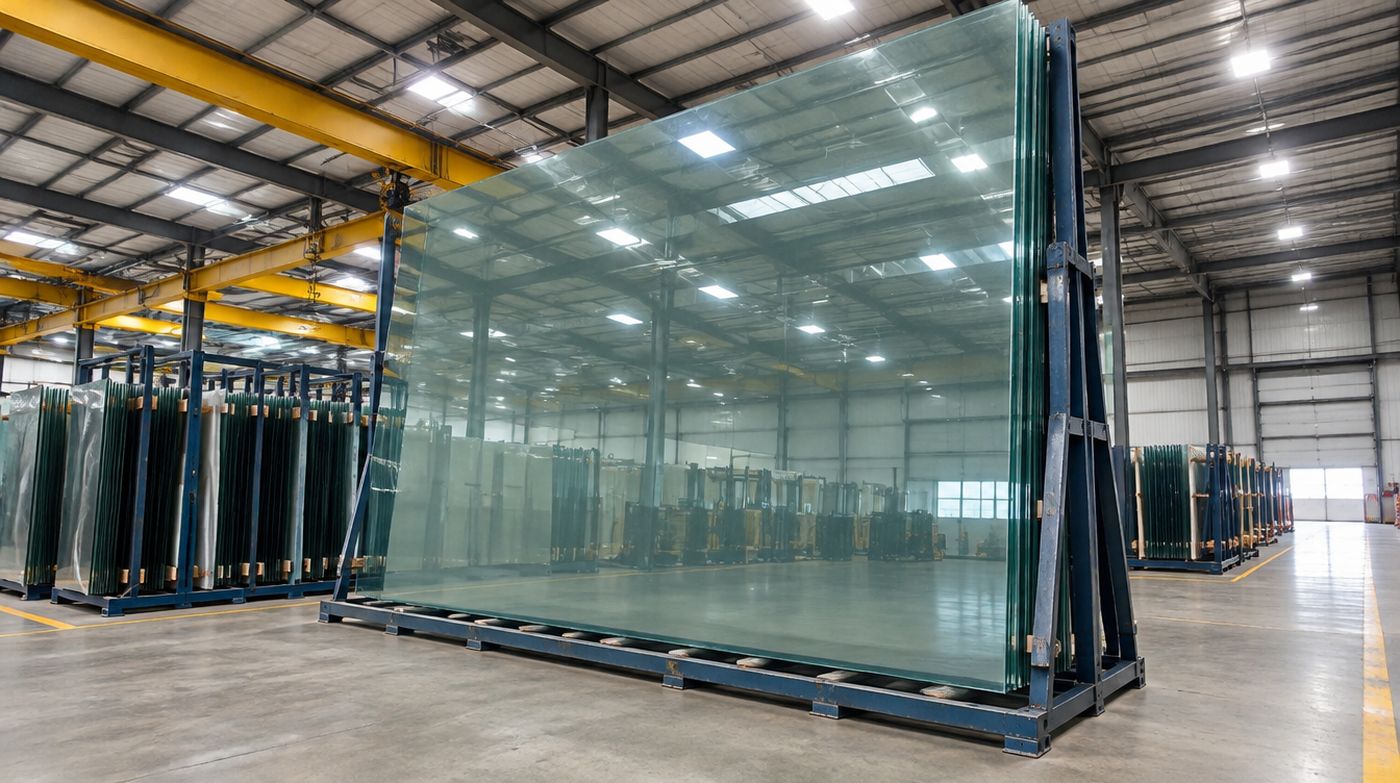
Is there a glass manufacturer in London at all?
Not in the sense most people mean when they search for one. Float glass, the flat clear sheet that nearly everything else starts life as, is made on a float line: molten glass poured onto a bath of liquid tin, drawn off as a continuous ribbon, annealed and cut into stock sheets. A float line runs without stopping for years at a time, burns an enormous amount of gas and needs sand, soda ash and limestone delivered in bulk. That is a very large industrial site with rail or water access, not a unit on an estate inside the North Circular.
So a search for a glass manufacturer in London returns processors and merchants, and some of them will describe themselves as manufacturers. That is not necessarily dishonest. In regulatory terms the company that performs the conversion giving the glass its properties is the manufacturer of that product. But it does mean the word on its own tells you almost nothing, and you need a sharper question than the one you started with.
Glass manufacturer, processor or merchant: who does what
The float producer makes the ribbon and sells stock sheets by the crate to the trade. They have no interest in your three panes and no mechanism for supplying them. A processor buys those stock sheets and converts them: cutting, edgework, drilling, toughening, lamination, sealed unit assembly. A merchant buys and sells, may hold stock, may cut basic sizes, and may factor out everything beyond that to somebody else.
The lines blur in practice. Plenty of merchants do their own cutting and edgework and send toughening out. Plenty of processors sell over a counter like a merchant. We sit on the processor side with a counter attached: stock sheets arrive at Atlas Road in Wembley, and cutting, arrissing, grinding, polishing, drilling, toughening, laminating and sealed unit assembly all happen in that building.
Two phrases deserve testing when you hear them. Made in our own factory can be true of a company that owns a cutting table and nothing else, with the toughening and the units bought in finished. And manufacturer’s warranty can mean the warranty of a company three steps up the chain that has never heard of you, rather than a commitment from the firm taking your money. Neither phrase is a lie. Both are worth one follow up question.
What matters to you is not the label a company chooses. It is which operations happen under its own roof, because those are the only ones where it controls the timetable and carries the fault without a conversation with a third party first.
What manufacturer means on your quote and your paperwork
For a toughened pane, the properties that matter are created in the furnace. BS EN 12150 covers thermally toughened soda lime silicate safety glass, and the company that tempers the pane is the manufacturer of that product. The same logic runs through laminated glass under BS EN 14449 and insulating glass units under BS EN 1279. The basic float itself sits under BS EN 572. The float producer made the glass. The processor made the product.
Which is why the declaration of performance and the UKCA or CE marking for a toughened pane come from the toughener rather than from the float plant, and why the permanent mark etched into the corner of a toughened pane identifies the processor and the standard it was made to. If a supplier cannot tell you whose mark will be on your glass, they are not doing the toughening.
If a supplier cannot tell you where the furnace is, they do not own the lead time they have just quoted you.
So ask the question in that form. Not whether they are a manufacturer, which invites a marketing answer, but whose name goes on the declaration of performance and whose mark ends up in the corner. Those answers are specific, checkable and hard to fudge.
Who is the manufacturer of a sealed unit?
Sealed units are where the question gets most tangled, because a unit is assembled from parts that four or five different companies made. The float or coated glass comes from one producer. The spacer bar comes from another, the desiccant from another, the primary and secondary sealants from others again. The company that puts them together under BS EN 1279 is the manufacturer of the unit, and it is that company whose production control, cavity width, gas fill and sealant cure you are relying on.
This is worth knowing because sealed unit failure is almost never a glass failure. Mist inside a cavity means moisture has got past a seal, and that comes down to how the unit was assembled and how it was then handled, glazed and drained in the frame. Chasing the glass producer over a misted unit is chasing the wrong company. The assembler is the one with the record, and the frame is the second place to look.
So when a supplier offers you units, ask whether they assemble them and what spacer they use as standard. We make ours up at Wembley to your cutting list with warm edge spacer as standard, which is a specification worth confirming rather than assuming, because aluminium spacer is still sold and still cheaper and performs worse at the edge of the pane.
Why the distinction matters when something goes wrong
It comes down to traceability. A toughened pane that fails without warning, a sealed unit that mists two winters in, a laminated panel with delamination creeping in from one edge: every one of those is investigated by going back to a production record. Who made it, on what date, from which batch, to what tolerance.
If the company you bought from performed the process, that record belongs to them and putting it right is one conversation. If they factored it out, your claim has to travel. You to the merchant, merchant to the processor, processor possibly back to the float supplier. Every step adds weeks and gives somebody a chance to say the glass was sound when it left them. You are not in those conversations and you cannot push them along.
That is the whole practical case for caring about the distinction. Not pride in British manufacturing and not marketing. A short accountability chain is worth real money on the day you need it and costs you nothing the rest of the time.
When you genuinely need the float manufacturer’s name
Usually you do not, and chasing it is wasted effort. For clear annealed, toughened or laminated glass in an ordinary application, which float plant produced the ribbon makes no practical difference to you. There are three exceptions worth knowing.
Coated products are the big one. Low emissivity coatings, solar control coatings and self cleaning glass are proprietary. The performance figures, the handling and edge deletion rules, and the warranty all belong to the coater. If a specification names a coated product, something with broadly similar numbers is not the same thing and should not be swapped in without a conversation. Ask which coating is actually going into the unit and get the answer in writing.
Low iron is the second. Different producers’ low iron products have slightly different colour, and if you are matching across a large installation or over two phases of a job you want the same product rather than the same description. The third is anything relying on a declared acoustic or structural interlayer performance, where the interlayer producer’s published data is what any calculation rests on, and substituting the interlayer invalidates the calculation even if the glass thicknesses are identical.
Questions that reveal who actually made your glass
Ask where the toughening furnace is and how far your glass travels between operations. Ask the maximum pane size they can toughen, because that is a physical property of a specific machine and anyone who owns one knows the number without looking it up. Ask how long a sealed unit sits before it is despatched. Ask what happens to a pane between the edging machine and the furnace.
None of these are clever questions. They are simply questions that cannot be answered convincingly by someone reading from a price list, and a few minutes of them will tell you more about a supplier than any amount of website copy, this page included.
The honest version of what we are
We are not a glass manufacturer in London in the float sense and we will not pretend to be. The clear, low iron, tinted, obscure, mirrored and coated stock we work from is made by companies running float lines, and we buy it the way everybody in this city buys it. What we do is the conversion, and we do all of it ourselves rather than passing your order round the M25.
If what you want is uncut stock sheets at distributor pricing, buy them from a national distributor and do not route them through us, because all we would add is a margin for handling them twice. If what you want is accurate conversion with nobody between you and the fault, that is exactly what this is, and the word on the letterhead is beside the point.
FAQ
Questions about glass manufacturer london
Is there a float glass manufacturer in London?
No. Float glass is made on continuous production lines that need bulk deliveries of sand, soda ash and limestone, very large volumes of gas, and the space to run a ribbon of glass uninterrupted for years at a time. Those plants sit on major industrial sites with rail or water access, not inside a capital city. Every company in London describing itself as a glass manufacturer is converting stock sheets made elsewhere: cutting, edging, toughening, laminating or assembling sealed units. That conversion is genuine manufacturing of the finished product, but it is not float production.
Does it matter who manufactures toughened glass?
It matters for accountability rather than for quality in the abstract. Toughening to BS EN 12150 is a controlled process, and a competent processor produces compliant glass whether they are large or small. What differs is what happens when a pane fails or a size is wrong. If the firm you bought from ran the furnace, the production record is theirs and the remake is one conversation. If they bought the toughening in, your claim has to travel through them to whoever did the work, which takes longer and gives everyone involved room to disagree.
How can I tell who made a pane of toughened glass?
Look in a corner. Thermally toughened safety glass carries a permanent mark, usually sandblasted or ceramic fired into the glass, identifying the processor that tempered it along with the standard it was made to. It is small and easy to miss, but it is there on compliant glass and it is the quickest way to check whether your supplier toughened the pane themselves or bought it in. The supporting paperwork, the declaration of performance, comes from the same company. If neither the mark nor the paperwork names your supplier, they factored the work out.
Send a cutting list or open an account
Lists quoted the same working day. Tell us the glass, the sizes and the processing and we will come back with a price and a lead time.