Glass supplier in London
How to buy glass well as a trade customer: what to specify, where the money goes, and what separates a good supplier from a cheap one.
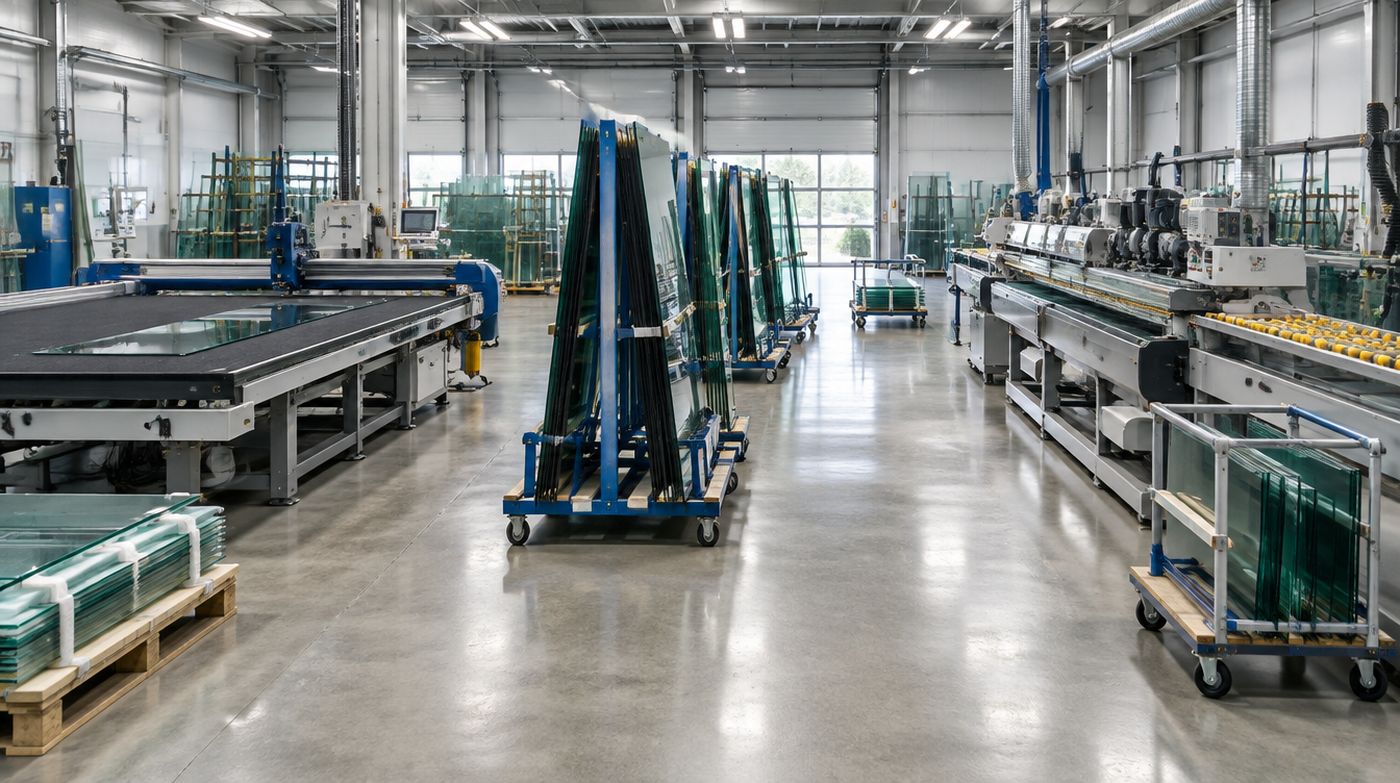
A glass supplier in London is easy to find and hard to choose. Anybody can send back a square metre rate. What separates one supplier from the next is whether the sizes come back right, whether the date holds, and what happens on the morning something is wrong. We process glass ourselves at Atlas Road in Wembley, so when you ring about a cutting list you are talking to the people who will cut it, not to a sales desk passing it along.
Everything below is written for someone who buys glass as part of their own work: a builder pricing an extension, a joiner making frames, a shopfitter working to a drawing, a kitchen fitter waiting on splashbacks, a maintenance contractor with a broken pane and a tenant, or a glazier whose own furnace is already full.
What we can process as a glass supplier in London
Cut to size from stock sheet. Edge work from arrised through flat ground to flat polished, plus bevels, radius corners, notches, cut-outs and drilled holes. Toughening to BS EN 12150. Laminating to BS EN 14449. Sealed unit manufacture on our own unit line, in the cavity and spacer the frame actually needs rather than whatever is convenient. Because the glass processing happens in one building in London, a panel that needs cutting, drilling, toughening and then making up into a unit does not travel between three separate companies to get there.
That matters for more than speed. Every handover between companies is somewhere a size can be transcribed wrongly, and somewhere responsibility gets blurred. A factored order goes out to a processor, comes back, and if a piece is 3mm oversize you are then in a conversation about whose fault it was while your fitter stands in a kitchen. When the whole sequence happens under one roof there is one number to ring and one company that owns the remake.
How are trade glass prices actually put together?
If you want to quote your own work properly you need to see how our number is built, because it is not a single rate with a margin on top. There are five things in it and they behave differently.
First, the product. A square metre rate for the glass itself, which varies enormously between plain float, low iron, a coated product, a patterned sheet and an acoustic laminate. Second, the minimum chargeable area, which is the floor under any piece regardless of how small it is. Third, yield, which is how much of a stock sheet your sizes consume including the offcuts nobody can use. Fourth, processing, charged per operation with a set-up behind each one. Fifth, delivery or collection, including crates and stillages if the load needs them.
Toughening sits slightly outside that structure because it is priced against furnace capacity. The bed is loaded flat, the cycle runs, and the cost of that cycle is roughly the same whether your three pieces are in it alone or sharing with a full load of the same thickness. A common thickness in a common product is therefore good value because it rides along with other work. An unusual thickness, a low iron sheet or an oversized panel can need most of a bed to itself and prices accordingly.
Trade glass prices are not a discount off retail. They are the same cost structure with the guesswork taken out, which is why a supplier who explains the structure is usually cheaper to work with than one who only sends totals.
Two practical consequences. If you are pricing a job with a handful of small panes, batch them into one order rather than drip feeding them, because each visit to the minimum charge costs you again. And if your client is comparing your price against a sheet they found online, the difference is usually processing and liability, not margin.
Stock or special order, and why it is your first question
We hold the products that move. Clear float across the common thicknesses, toughened stock sizes, standard laminate, the usual low emissivity coated product for sealed units, mirror and a couple of obscured patterns. Everything else is brought in, and brought in means a supplier’s delivery day, not an afternoon.
So before you quote, ask what is on the rack. Not what is available, not what is in the brochure, but what is physically on the rack this week. A supplier who will tell you honestly that something is a two or three week item is doing you a favour, because you can either build that into your programme or steer the client to something we hold. A supplier who says yes to everything and then goes quiet has moved their problem onto your site.
Lead times, process by process
Cutting from stock is quick and the limit is the queue in front of you. Arrised edges go on as part of the cut. Flat ground and flat polished edges, shapes, notches and holes mean another machine and another pass, so a list with heavy processing is not the same job as a list of plain rectangles even if the glass is identical.
Toughening is batch work. Your pieces wait for a bed that suits them and then run. Laminating is slower again, which is why most laminate goes out as a stock product cut to size rather than made from scratch. Sealed units need their components ready, including toughened or coated panes, then assembly, sealing and curing before they can be stood in a van. A unit that has to be toughened first is two processes in sequence, and it is worth saying that out loud when you order so your expectation and ours match.
We will give you a date rather than a range of wishes, and if the date moves you will hear it from us before you hear it from your client. That is the whole of our promise on timing. Same day on toughened is not something we will claim, and if a competitor does, ask them which furnace cycle yours is going into.
Breakage, remakes and who pays
A remake policy only works if it runs both ways, so here is ours in plain terms. If we cut to the sizes on your written order and a piece is outside tolerance, that is ours. We remake it and we prioritise it, because the mistake was made in our building. If we cut exactly to the sizes you gave us and the opening turns out to be different, that is yours, and it is yours whether the measurement came from you or from your client.
Glass breaks in transit and in handling, and the honest position is that it is almost always obvious which has happened. A crack running from a nipped edge with a fresh chip at its origin is handling damage. A sealed unit with a clean break across the face and intact edge seals on arrival is a transport issue. Tell us straight away and we will deal with it straight away. What makes claims difficult is a pane that was signed for as sound and then reported as broken three days later, by which time nobody can honestly say where it happened.
One hard fact about toughened glass: nothing can be done to it after the furnace. It cannot be cut, drilled, notched or even nibbled. That is why we query cut-out positions before a panel goes in rather than after, and why we would rather ring you about an ambiguous line than guess and be fast.
What does a trade account actually change?
A trade account gives you a pricing tier based on what you genuinely buy rather than what you hoped to buy, agreed payment terms instead of paying at the counter every time, a named contact who has seen your previous orders, standing instructions so you do not restate your edge preference on every list, order history you can refer back to when a client wants the same again, and the ability to send a driver to collect without settling up first.
It does not do a few things, and it is worth being blunt about them. It does not move you up the toughening queue ahead of work already loaded. It does not remove minimum chargeable areas, because the handling cost is real whoever is paying it. It does not make a special order arrive sooner than the supplier ships it. And it does not transfer responsibility for sizes from you to us. An account is a commercial arrangement, not an insurance policy against a tape measure.
When the client gave you the measurements
This is the position every fitter ends up in. A client or a main contractor hands you sizes, you pass them on, and if they are wrong the glass is still cut and still chargeable. There are only two safe ways to handle it.
The first is to measure yourself and own the figures. That is the right answer on anything toughened, anything with processing, anything going into a finished frame, and anything expensive. Half an hour with a tape is cheaper than a remake every single time.
The second is to order to supplied sizes and record that you have done so. Put it on the order in writing, state on your own quotation that the glass is cut to the client’s sizes and that remakes due to incorrect dimensions are chargeable, and keep the email. We will note supplied sizes on our paperwork if you ask us to. What you should not do is accept verbal sizes, pass them on, and hope. Check the opening for square while you are there too, because a surprising number of older London openings are out by enough to matter once a rigid panel goes in.
What to check before you sign the delivery note
Signing is the moment risk moves. Take the two minutes. You are looking for five things.
Edges and corners
Run your eye along the exposed edges, especially on polished work and anything toughened. Small shells and chips at an edge are not just cosmetic on toughened glass, they are the places a panel will eventually break from. Corners take the worst of handling, so look there first.
Sealed units
Look through the unit, not at it. A hazy or slightly milky appearance between the panes, or any sign of moisture, means the unit has failed or was vented. Check the seal line is even all the way round, that the spacer sits square and that the edge tape has not lifted. A unit that has been dropped flat often shows a dished or distorted reflection before it shows anything else.
Roller wave and orientation
All horizontally toughened glass has slight roller wave, a gentle ripple picked up as it travels through the furnace. It runs in one direction and it is normal. What matters is orientation, because wave running vertically in a shop front or a balustrade is far more visible in reflection than wave running horizontally. If a panel is going somewhere people will see reflections across it, say so when you order and the orientation can be planned.
Coated glass and which way round
Coated products have a face. A low emissivity coating belongs on a particular side of the cavity, a solar control coating likewise, and a mirror or backed product has an obvious back. Units are normally marked or labelled for orientation. If a label has come off and you are not certain, ring us before it goes in rather than after, because a unit fitted the wrong way round performs differently and no amount of arguing changes that.
Labels, stamps and paperwork
Safety glass carries a permanent mark identifying the product and the standard it was made to, and it has to stay legible after installation in a critical location under Approved Document K. Check the stamp is there and sits where it will still be visible. Take the delivery note and the specification with you and keep them with your job file, because if a building control officer or a client’s surveyor asks what the glass is, the mark and the paperwork are the answer.
Why the cheapest quote on a cutting list is often the most expensive job
Compare three quotes line by line and the cheap one usually turns out to have priced something different. Arrised where you asked for polished. Annealed where the location needs toughened to BS 6206 Class A. Standard float where you specified low iron, which will read as a green cast on every visible edge of a pale splashback. A thinner laminate than the one the barrier calculation under BS 6180 assumed. Delivery excluded, or a collection-only price for a load your van cannot legally carry.
Then there is the cost that never appears on a quotation. A wrong panel means a second fitting visit, a rescheduled client, idle labour and in a shopfitting or occupied-building context sometimes an out of hours return. Set that against the saving and the arithmetic is rarely close. Buy on specification and on who answers the phone when it goes wrong.
Ordering, collection and delivery
Send the cutting list by email so there is a written record of the sizes, and we will come back with a price against it the same working day in normal circumstances. Ring first if it is complicated, then send it anyway. Collection is from the Wembley workshop between 8am and 5pm Monday to Friday, and glass travels on edge in a proper frame or rack, never flat across a roof bar or leaning loose in the back of a van. Delivery runs across Greater London, and we are straightest with customers across north west and west London where most of our trade work sits.
If you are not sure which product the job needs, describe the situation rather than guessing a specification. Where the panel sits, whether anyone can fall against it, whether it is a door side panel, whether it needs to stop noise or heat, what the frame is. We would rather spend five minutes getting that right with you than make something that technically matches an order and does not suit the job.
FAQ
Questions we get asked
Do I need a trade account to buy from you?
No. Accounts suit customers ordering regularly, because they bring agreed terms and simpler ordering, but anyone can buy on a cash sale. The pricing difference reflects volume and payment terms rather than who you are.
Are you a merchant or a processor?
Both, and the distinction matters when something goes wrong. A lot of merchants factor glass in from a processor and add a margin. Our cutting, edgework, drilling and toughening happen at HA9, so when a pane is damaged or a size changes, the remake is in our hands rather than in a queue at someone else's factory.
How quickly can you turn a cutting list around?
Plain float cut and polished is usually a few working days. Toughened adds furnace time, laminated depends on stock build-ups, and sealed units sit at the longer end. We confirm the lead time with the quotation rather than after you have committed to your customer.
Can I get glass the same day?
Sometimes, for straightforward cuts in stocked thicknesses when we have capacity on the table. It is never a promise made over the phone without checking. Toughened glass is never same day, because the furnace cycle alone takes hours and the processing comes first.
Who carries the risk on sizes?
If the sizes are yours, they are yours. We will query anything that looks inconsistent, and we would rather make that call than cut something we suspect is wrong, but we cannot verify a measurement we did not take. Where we survey, the sizes and the remake are ours.
What do I need to collect glass safely?
A vehicle that lets the glass stand on edge, something padded to stand it against and a strap. Glass must never travel flat, because a sheet lying down flexes over every bump and that is how it breaks in transit. Bring a second pair of hands for anything large, and check the edges before you leave.
Send a cutting list or open an account
Lists quoted the same working day. Tell us the glass, the sizes and the processing and we will come back with a price and a lead time.