The yard behind the counter
A working glass processing unit on Atlas Road in Wembley.
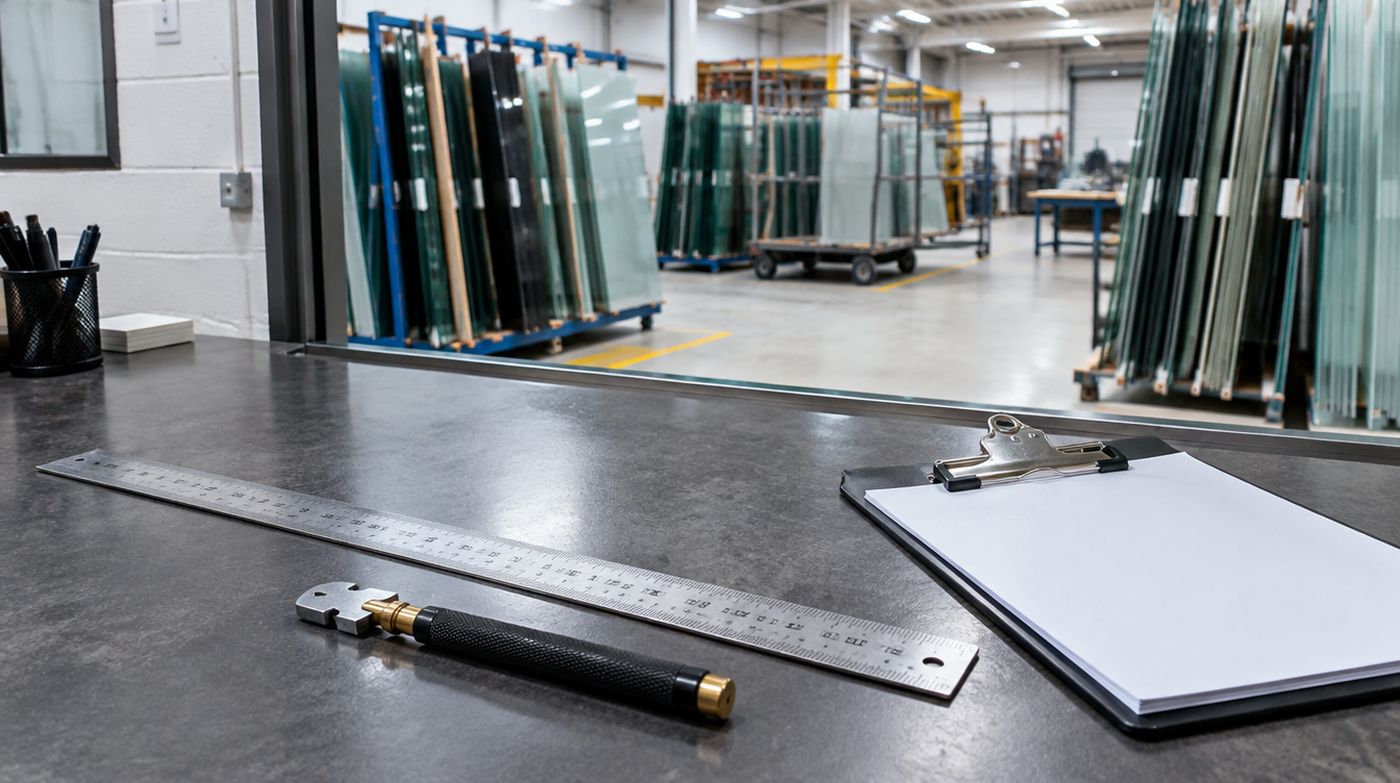
A glass merchant with its own workshop, not a catalogue with a phone number
Glass Merchant London is the trade counter side of a glazing business that cuts and processes its own glass at 6 Atlas Road in Wembley, HA9 0JH. We supply builders, joiners, shopfitters, kitchen and bathroom fitters, maintenance contractors, property managers and other glaziers. Some of our customers order every week, some twice a year when a pane goes through in a block they manage, and both are treated the same way at the counter.
People use glass merchant, glass trade supplier and glass wholesaler in London fairly loosely, and the words matter less than the question behind them. The real question is where the glass actually gets processed. A merchant who factors everything is a buying office. Your list goes out to a processor, comes back, gets checked by somebody who was not there when it was cut, and when a size is wrong you are in the middle of a conversation between two companies while your fitter waits. We process in house, which means the remake is ours without debate and the person on the phone can go and look at your glass.
What happens to your order inside the building
An order arrives as a cutting list, usually by email so the sizes exist in writing. Someone reads it looking for ambiguity before anything else happens. Lines that say 900 x 1200 with no orientation, holes dimensioned from an unnamed corner, pairs that might be handed, an edge finish that applies to some edges and not others, a coated product with no stated room face. If we spot one of those we ring you. That call is not us being slow. It is the cheapest thirty seconds in the whole process.
The list then gets optimised onto stock sheet so your sizes nest with as little waste as possible, cut, and sent to whichever machines the specification needs. Arrising happens as part of the cut. Flat ground and flat polished edges, bevels, radius corners, notches, holes and cut-outs each mean a separate pass. Anything toughened waits for a furnace bed that suits its thickness and then runs through a cycle to BS EN 12150. Laminated work is handled to BS EN 14449. Sealed units are assembled on our own line, sealed and then left to cure properly before they are stood in a van, because a unit that travels too early is a unit that fails early.
Then it is labelled, racked on edge and either put aside for collection or loaded for delivery. Glass stands on edge at every stage from the cutting table to your workshop floor, and anyone who tells you a pane can safely travel flat across a van floor has not carried enough of it.
Standards we work to, and the paperwork behind them
Technical accuracy is not a selling point in this trade, it is the baseline, but it is worth being explicit about what we will put behind a job. Toughened glass is processed to BS EN 12150. Laminated glass is made and supplied to BS EN 14449. Where glass sits in a critical location as defined in Approved Document K, meaning low level glazing, door glass and the panels beside doors, it is supplied as safety glass satisfying BS 6206 Class A or the equivalent impact classification, and it carries a permanent mark saying so.
Where glass forms part of a protective barrier, a balustrade or a juliet balcony, the thickness and make-up need to follow the loading requirements of BS 6180 rather than whatever looks about right. We will ask what the barrier is protecting and what loading has been assumed, and if nobody on the job knows, we will say that it needs establishing before anything gets cut. Sealed units for replacement windows are specified with Approved Document L in mind, and where security requirements under Approved Document Q apply to a new dwelling, laminated make-ups are the usual answer.
The company is a FENSA registered installer, which matters when we are fitting rather than supplying. If you are buying glass over the counter to install yourself, your own competence and your own certification scheme cover the installation, not ours. We will not pretend otherwise and we will not issue paperwork for work we did not do.
The marks on the glass and the delivery note are your evidence. Keep them with the job file, because a client’s surveyor asking what the glass is six months later will accept a stamp and a specification, and nothing else.
What we will not do
We will not quote a job we have not understood. If the description is thin, we will ask questions, and if the answers are not available we will say so rather than putting a number on guesswork.
We will not sell you a heavier or more expensive make-up than the situation needs. A fixed window at first floor height with nobody able to fall against it does not need toughening because it is upstairs. A splashback behind a hob does need toughening, and it needs low iron if the wall behind it is white or pale and anyone will be looking at the edges. A small internal shelf does not need polished edges on the two sides nobody can see. Telling customers which parts of their specification to drop is how an account lasts a decade.
We will not promise a date to win an order. If the toughening queue means Thursday, it means Thursday, and you can plan properly around an honest Thursday. We will not claim same day on toughened. And we will not quietly substitute a product. If what you specified is not available and something else would work, you will be told before it is cut, not when it arrives.
What makes a customer one we look after
Every processor has a handful of customers who get the benefit of the doubt, and it is not about volume. It is about how easy the work is to do right. The pattern is consistent across the trade, so it is worth knowing what it looks like from this side of the counter.
- Lists arrive in writing, with width and height labelled, product and thickness stated and edge work specified per piece
- Sizes are measured by the person ordering, or supplied sizes are flagged as supplied
- Questions get answered the same day, because a job held up waiting for a reply loses its place in the queue
- Collection happens roughly when it was agreed, with a vehicle that can carry the load on edge
- Breakage gets reported at delivery rather than days later
- Programmes are shared early, so a long lead item is ordered when it is known about rather than when it becomes urgent
Do those things and you will find the odd awkward favour comes back your way: a piece squeezed onto a bed that was about to run, a late Friday collection, a judgement call going in your direction when a damaged pane is genuinely ambiguous. None of that is policy. It is what happens when working with someone is straightforward.
The reverse is also true and nobody pretends otherwise. Verbal sizes, lists that change after cutting has started, repeated claims on damage spotted long after signing, and vehicles that turn up unable to take the glass all make a customer expensive to serve, and expensive customers end up at the back of the queue.
Hours, contact and opening an account
The workshop and counter are open Monday to Friday, 8am to 5pm, at 6 Atlas Road, Wembley HA9 0JH. The number is 020 4634 6045. Cutting lists are best sent by email so the sizes are on record, and in normal circumstances you will have a price back the same working day.
Opening an account is a short conversation about what you buy and how often, followed by the usual checks. You do not need an account to buy from us and plenty of regulars pay as they go. What an account gives you is a settled pricing tier based on real volume, terms, standing instructions on edge work and tolerances, and someone who knows your previous orders without being told. What it does not give you is a shortcut past the furnace queue or past the responsibility for your own measurements, and any supplier who implies otherwise is selling you something that does not exist.
If you are weighing us up against another glass processing company in London, the fair test is a real cutting list with some processing on it. Send the same list to two or three suppliers, read the specification lines rather than the totals, and ask each one what happens if a size comes back wrong. The answers to that last question tell you more than the prices do.
Send a cutting list or open an account
Lists quoted the same working day. Tell us the glass, the sizes and the processing and we will come back with a price and a lead time.