Areas we cover across London
We work from our workshop at 6 Atlas Road, Wembley HA9 0JH, across Greater London and the near Hertfordshire border.
Core coverage
Where most of our work is
Being based in Wembley means north, west and central London are on our doorstep. These are the areas we are in most weeks.
- Wembley
- Harrow
- Brent
- Ealing
- Camden
- Westminster
- Kensington & Chelsea
- Hammersmith & Fulham
- Barnet
- Islington
- City of London
- Watford
Full list
Every area we survey and install in
- Wembley
- Harrow
- Brent
- Ealing
- Acton
- Willesden
- Kilburn
- Camden
- Islington
- Westminster
- Marylebone
- Fitzrovia
- Mayfair
- Kensington
- Chelsea
- Hammersmith
- Fulham
- Chiswick
- Shepherd's Bush
- Notting Hill
- Maida Vale
- St John's Wood
- Hampstead
- Highgate
- Finchley
- Barnet
- Mill Hill
- Edgware
- Stanmore
- Pinner
- Northwood
- Ruislip
- Uxbridge
- Hayes
- Southall
- Greenford
- Wood Green
- Enfield
- Walthamstow
- Hackney
- Shoreditch
- City of London
- Clerkenwell
- Southwark
- Battersea
- Wandsworth
- Richmond
- Twickenham
- Kingston
- Watford
- Bushey
- Borehamwood
Not on the list? If you are within the M25 it is worth a call. We travel for larger projects and can usually fit a survey around work already booked nearby.
What we do across these areas
- Glass supplier in London
- What a glass trade supplier should actually give you
- Looking for a glass manufacturer in London? Read this first
- Glass suppliers in north west London, and what being close is actually worth
- Trade glass prices, and why two quotes for the same list never match
- Glass processing in London: what each operation does and when it has to happen
- Using a glass merchant in Wembley: collection, access and the practical bits
Supplying glass across London is a logistics problem before it is a glass problem. The product is heavy, rigid, awkwardly shaped and unforgiving of a pothole, and it has to arrive in a city built around a Victorian street plan with a modern permit system laid over the top. Where your workshop or site sits changes how a load gets to you, how long it takes and what you need to have ready when it turns up. We work from 6 Atlas Road in Wembley, HA9 0JH, and the geography below is the honest picture rather than a list of postcodes.
Collecting from the Wembley workshop
Collection is from Atlas Road, Monday to Friday between 8am and 5pm. For a lot of trade customers in north west London it is quicker than waiting for a delivery slot, and if you are already moving between jobs around Park Royal or Wembley it costs you very little time. We sit a short run from both the North Circular and the A40, so access from either side of west London is straightforward most of the day.
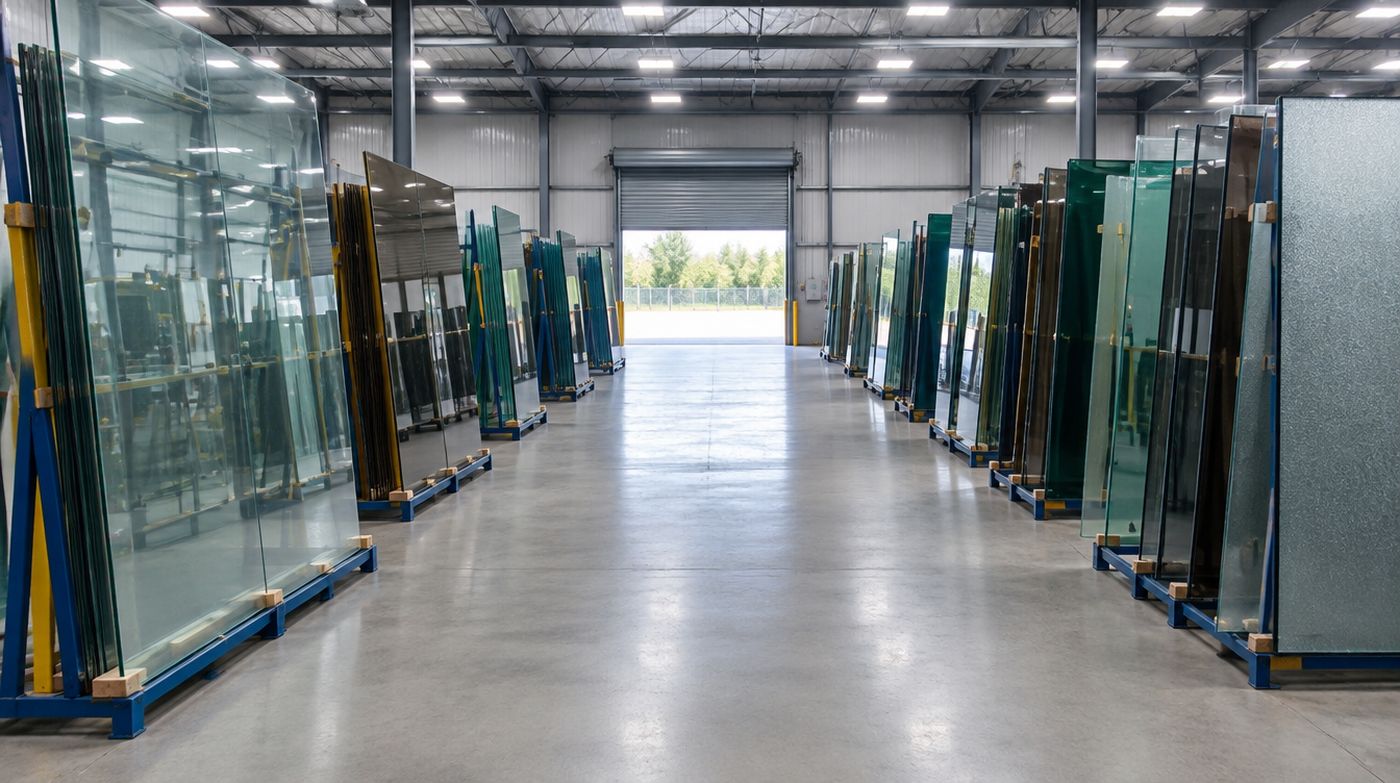
Two local realities to plan around. The North Circular around the Wembley junctions is slow at both peaks and the slowness is not predictable, so a mid morning or early afternoon collection is a far easier journey than one at half past four. And on stadium and arena event days the whole area around Wembley changes. Roads close, parking restrictions extend, and traffic builds for hours before kick off and again afterwards. Check the fixture list before you plan a late afternoon collection, or come in the morning.
The vehicle matters more than people expect. Glass must travel on edge, supported along its length and strapped so it cannot slide or rock. A proper internal rack or an A frame is ideal. A van with a flat bulkhead and sensible blankets and straps will do for modest sizes. What will not do is glass lying flat on a van floor, leaning loose against a side panel, or going on a roof bar. Flat glass flexes over every bump and a sealed unit laid flat takes the load through its seals rather than its edges. We will help you load and we will say so if what you have brought is not up to the size you have ordered, because sending a panel out to break in your van helps nobody.
Tell us the sizes when you book the collection. A 2400mm toughened panel is a two person lift and needs a vehicle that can genuinely take it on edge with the doors shut. If the glass will not fit safely, we would rather put it on a delivery than watch it leave badly.
The north west and west London trade belt
Most of our trade work goes out across a belt that starts at Park Royal and runs through Acton, Harlesden, Perivale, Greenford, Hayes and Southall, taking in Alperton, Wembley itself, Ealing and the industrial pockets around Northolt. This is where London’s joinery shops, shopfitters, kitchen manufacturers, window companies and metalwork fabricators actually sit, and for anyone looking for glass suppliers in north west London it is also the part of the city where a same week delivery is realistic rather than optimistic.
Deliveries here are usually to a unit rather than a site, which makes them the easiest we do. There is normally somewhere to pull up, a roller shutter, a pallet truck and someone who understands glass. The one thing worth getting right is where the load is going to stand. Have a wall or a rack clear before the van arrives. Glass that has to be stood somewhere temporary and then moved again is glass that gets chipped, and the chip will be on the edge you were going to polish.
Park Royal and the estates around it have their own quirks: narrow internal roads, units served off shared yards, delivery bays that double as someone else’s parking and gates that are locked outside their own hours. If your unit is behind a barrier or needs a code, tell us when you order rather than letting a driver sit outside ringing a mobile that is in a workshop with a saw running.
North London, Barnet round to Enfield and Tottenham
North London splits into two different jobs. The suburban stretch through Barnet, Finchley, Mill Hill, Southgate and out towards Cockfosters is mostly 1930s semis, interwar terraces and purpose built flats, with reasonable road widths and usually somewhere to park. Deliveries there behave normally. The constraint is more often the property than the street: side returns too narrow to carry a large panel through, rear gardens reached only through the house, and conservatories and extensions where the glass has to be walked round a building rather than carried straight in.
Further east through Wood Green, Tottenham, Edmonton and into Enfield the mix changes to Victorian terraces, converted flats, shop parades with flats above and a lot of maintenance work. Here the issue is kerbside space and bus routes. A shop front panel on a parade with no loading bay and a red route outside needs the delivery timed and the labour standing ready, because a van cannot sit there while someone finds a key.
If a load is going to a converted flat, say which floor and whether there is a lift. A large sealed unit up a narrow Victorian staircase with a turn in it is sometimes physically impossible, and it is far better to establish that at the quoting stage than with a driver and a unit on the pavement.
Central London, where the rules cost more than the miles
Delivering into Westminster, Camden, Islington, the City, Kensington and Chelsea or Southwark is rarely about distance. It is about everything layered on top of the drive. The Congestion Charge applies on its own hours and days, the ULEZ now covers the whole of Greater London so the vehicle has to meet the standard wherever it starts from, and red routes on the main arteries mean there is simply nowhere legal to stop for the length of time an awkward unload takes.
Then there are timed loading bays, which are genuinely useful if you know where the nearest one is and useless if you do not. On managed buildings and commercial sites add site inductions, a named contact at the door, out of hours delivery windows, goods lift bookings with a dimension limit, and buildings where anything long has to go up a stair core because the lift car will not take it. Any one of those can turn a twenty minute delivery into a morning.
What this means in practice is that central deliveries need information from you before they need a van from us. Tell us the access arrangement, who meets the driver, whether there is a booking slot and reference, the lift dimensions if the glass is going above ground floor, and whether any induction or permit is required. Where a site has a strict slot, we will work to it, but a slot missed because nobody told us about the barrier is a wasted journey for both of us.
It is also worth saying plainly that for some central jobs collecting the glass yourself and running it in with your own fitters in a vehicle you already have permitted is cheaper and more reliable than a delivery. We will tell you when we think that is the case.
South and east, across the river
We deliver south and east, into Wandsworth, Clapham, Battersea, Lewisham, Greenwich, Bromley and across to Stratford, Hackney, Bow and the Docklands, but the river changes the arithmetic. The crossings are the constraint, not the mileage. The Blackwall and Silvertown tunnels carry a charge, the Dartford crossing carries its own, and crossing times at both peaks are unpredictable enough that an early slot is worth more than a convenient one.
East London has a lot of new build and conversion work, which brings managed estates, service yards, barriered access and construction logistics regimes, especially around Stratford and the Docklands. South London brings long suburban runs and some genuinely tight Victorian streets in places like Peckham, Deptford and Forest Hill, with permit parking that leaves no legal space outside the property. Where a load is going somewhere like that, a morning delivery with two pairs of hands ready at the door is the difference between a smooth drop and a driver circling.
Outer London and the edge of the M25
Out towards Uxbridge, Watford, Harrow, Pinner, Ruislip, Croydon and Romford the roads get easier and the distances get longer, so deliveries are planned around routes rather than requests. If you are outside our strongest patch, the practical approach is to combine orders rather than send three small ones, and to be flexible on day if you want to avoid a dedicated run. Collection from Wembley is often the sensible option for customers to the north and west, since Atlas Road is a straightforward trip from most of that arc.
Site delivery or workshop delivery
These are not the same thing and they should not be priced or planned as if they were. A workshop delivery goes to people who handle glass daily, into a space designed for it, with equipment to move it. A site delivery goes to a building where glass is one of forty things arriving that day, where the floor may be wet or uneven, where there is often nowhere safe to stand a panel, and where the person meeting the driver may not be the person who ordered it.
Our preference, and our honest advice, is to take glass to a workshop wherever the job allows it and let your own team bring it to site when they are ready to fit. Glass sitting on a site for a week is glass that gets leaned on, walked into and used as a bench. If it has to go direct, book a slot and make sure the labour to take it off the van is there at that slot. A driver cannot carry a large unit into a building alone and should not be asked to.
Before a load arrives, have the route in and the standing place clear, decide who is signing, and make sure the opening has been checked if the glass is a replacement. Finding out that an opening is 15mm out while a toughened panel is sitting in your hallway is the worst possible moment to find out.
Checking a load and claiming for damage
Look at the glass before you sign, not after the van has gone. Walk the edges and corners for chips and shells, look through sealed units for haze or moisture rather than looking at them, check the seal line and spacer, check labels and orientation marks on coated products, and count the pieces against the delivery note. On polished work, look along the edge at a low angle where a nip shows up most clearly.
If something is wrong, write it on the delivery note before you sign, keep the note, and ring us the same day. Photographs taken where the glass is standing, including the crate or rack, settle most questions in minutes. Damage reported at the point of delivery is dealt with quickly because the circumstances are clear. Damage reported days later, on a pane signed for as sound, is a much harder conversation for everybody, and that is not a policy position so much as a fact about what anyone can honestly know after the event.
Across every part of London the same principle applies. The delivery is the point where the glass stops being our responsibility and starts being yours, so spend the two minutes it takes to be certain it arrived right.
Send a cutting list or open an account
Lists quoted the same working day. Tell us the glass, the sizes and the processing and we will come back with a price and a lead time.