Glass suppliers in north west London, and what being close is actually worth
North west London holds most of the glass processing capacity in the capital. This page is about why that happened, what it changes for you on a live job, and where proximity stops mattering.
Why the glass trade clusters in north west London
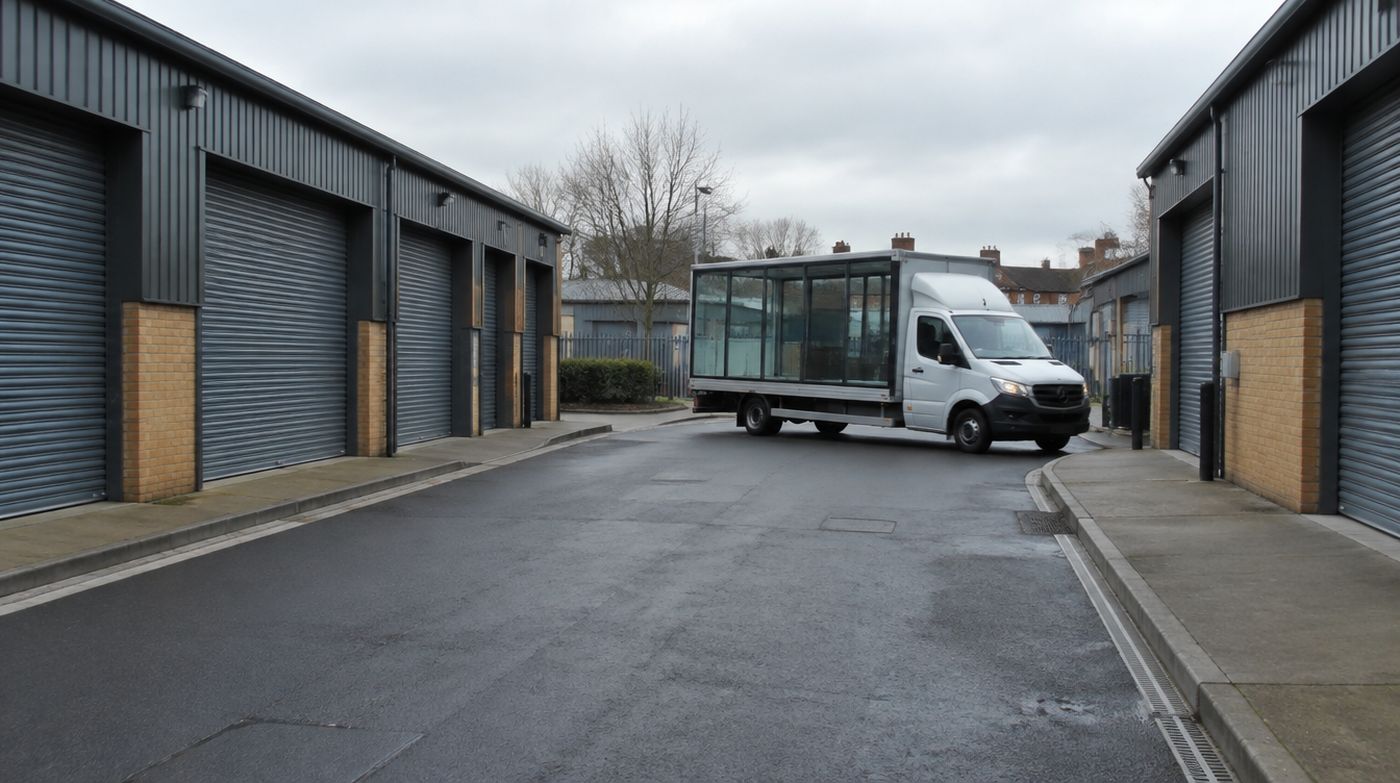
The glass suppliers north west London runs on are concentrated in one belt of industrial land, and that is not an accident of planning. Park Royal, Acton, Harlesden, Alperton, Perivale, Greenford and Wembley form one more or less continuous stretch of industrial land along the A40 and the North Circular, built up around the Grand Union Canal and the rail yards and never redeveloped out of existence the way the riverside industrial land closer in was. Glass processing needs precisely what that belt still offers: high bays for racking stock sheets, three phase power for a furnace, hardstanding a lorry with a trailer frame can actually turn on, and a road out that does not run through a town centre.
That is why glass suppliers in north west London are not spread evenly across the capital. If you work in Brent, Ealing, Harrow, Camden, Westminster or Barnet, you are within half an hour of most of the processing capacity in the city. If you work in Bexley or Bromley, you are not, and that is a genuine operational disadvantage rather than a detail. It shows up in how your week is shaped, not in your material cost.
Our own workshop is at 6 Atlas Road in Wembley, which sits in that belt on the Harrow Road side, close to the North Circular at Stonebridge Park and a few minutes from Park Royal. Everything below is written from the experience of supplying out of that corner of the city.
What proximity to a glass supplier is worth in money
It is easy to treat a supplier’s location as a line on an invoice called delivery. It is not. It is an option on your own time, and the option is worth more than the charge.
Here is the concrete version. You measure an opening on Tuesday, the glass is cut Wednesday, and on Thursday morning your fitter finds the reveal is 8mm out because the plaster went on thicker than anyone expected. If your supplier is twenty five minutes away, somebody drives over, the pane is recut that morning or that afternoon, and the job finishes on Thursday. If your supplier runs a scheduled delivery from outside the M25, the job finishes next week, you have two men to find work for, and you have a conversation with the client you did not want to have.
That same option covers the extra pane you forgot to put on the list, the one that gets broken on site at ten in the morning, and the piece the client changed their mind about after seeing it in. None of those are planned. All of them are completely normal. A supplier you can reach and collect from on the same day turns each of them from a problem into an errand.
Glass suppliers north west London: what changes borough by borough
The phrase north west London covers wildly different work, and the housing stock decides what the glass job actually involves long before anyone gets a tape out.
Brent: Wembley, Willesden, Neasden, Kilburn
Around the stadium in HA9 the stock is new build towers and managed blocks: concierge at the door, a goods lift that has to be booked, delivery windows that are not negotiable, and the plain reality that a pane goes up in a lift with blankets round it or it does not go up at all. Measure the lift before you confirm a size. Further out towards Willesden, Neasden and Dollis Hill it swings back to interwar semis and terraces with repeating openings and straightforward kerbside loading. Kilburn and the Camden border bring tall Victorian terraces and controlled parking on almost every street.
Ealing and the W postcodes
Acton, Hanwell, Northfields and Ealing Broadway are Edwardian and interwar housing with a lot of original timber: bay fronts, stair windows and front doors with obscure patterns that have to be matched from a fragment rather than chosen from a range. The conservation areas across Ealing, and Bedford Park in particular, mean the frame is frequently not up for discussion, so the glass has to suit an opening built for 3mm or 4mm single glazing. Thin cavity sealed units and laminated single pane replacements come up constantly on this side of the city.
Harrow and the HA postcodes
Rayners Lane, North Harrow, Kenton, Wealdstone and Stanmore are 1930s semis in volume. Side access most of the time, a driveway to park on, and openings that repeat from house to house, which makes a consolidated cutting list genuinely efficient if you can measure several together before ordering. Pinner and Harrow on the Hill add conservation constraints and a stricter view of what is allowed to be visible from the street.
Camden, the NW inner postcodes and the Westminster edge
West Hampstead, Queen’s Park, Kensal Rise, Hampstead and Maida Vale are where access becomes the dominant cost. Mansion blocks with communal stairs and a lift nobody can get a 2 metre pane into. Narrow terraced streets where a long wheelbase van stops traffic the whole time it is unloading. Controlled parking nearly everywhere, often all day. Listed buildings and conservation areas that decide what glass is permitted before the survey even happens, which in practice means more single glazed and slimline work and more laminated used where double glazing is not allowed.
Barnet and the outer north
Finchley, Golders Green, Hendon and Mill Hill mix 1930s semis with larger detached houses, and the work tilts towards rear extensions, roof glazing and bigger openings. That means heavier panes, more overhead laminated, and more jobs where the glass cannot be carried through the house at all and has to go over a fence or down a side return that somebody needs to measure honestly before the pane is made 2.4 metres long.
Access, parking and the things that quietly ruin a delivery
Three practical constraints repeat across the whole north west. Controlled parking zones, which cover most of the inner boroughs and plenty of the outer ones, and which need either a permit, a dispensation or a suspended bay arranged in advance rather than on the morning. Red routes along the A406 and the A40, where stopping is not permitted at all, so the last part of the journey has to come off the main road. And side access, or the absence of it, on terraced streets where the only way to the back of the house is through the middle of it.
Tell your supplier about the access problem when you order, not when the van arrives. A pane cut 2.4 metres long for a rear extension on a terrace with a 700mm side return is a pane that goes back on the van, and nobody wins that argument on the pavement. If the route in is tight, the answer is usually to split the glazing into two panes with a post, and that decision has to be made before anything is cut.
When a nearer glass supplier is the wrong choice
Proximity is worth a lot but it is not worth everything, and it is worth saying so on a page like this. If you are running forty identical sealed units for a block, the question is capacity and unit price, not drive time, and a large processor further out will often beat anyone local on both. If you need fire rated glazing, a specific coated product or an unusual thickness, buy it from whoever genuinely has it rather than from whoever is closest, and accept the lead time that comes with it.
And do not pay a delivery charge to a supplier whose unit you drive past twice a day. Collect it. The number of trade buyers paying for delivery out of habit on a route they already take is higher than you would think, and it is the easiest money on this page to stop spending.
How to make a local supplier actually pay off
Being close only helps if you use it. Ring before anything is cut if there is the slightest doubt in a size, because a two minute call is cheaper than a recut and far cheaper than a wasted visit. Consolidate the week where you can, then keep one slot free for the piece that will inevitably come up on Wednesday.
Order the awkward item first and the simple ones later. Shapes, holes, bevels and anything needing a template take time at the table, and they are the pieces most likely to raise a query, so get them into the system early and leave the clear rectangles until the end of the week. And keep a standing specification for the glass you buy most, so a repeat order is a quantity and a size rather than a fresh conversation every time.
FAQ
Questions about glass suppliers north west london
Which areas count as north west London for glass supply?
In practical terms the NW, HA and W postcodes plus the north western edge of Camden and Westminster. That takes in Wembley, Willesden, Harlesden, Park Royal, Alperton, Acton, Perivale, Greenford, Harrow, Pinner, Stanmore, Kilburn, West Hampstead, Queen’s Park, Hampstead, Finchley, Golders Green and Hendon. The reason it matters is that most of the glass processing capacity in the capital sits inside that area, along the A40 and North Circular industrial belt, so firms working there can usually collect the same day rather than waiting for a delivery run.
Is it cheaper to collect glass than to have it delivered?
Usually, if the journey is one you were making anyway or the workshop is genuinely close. Delivery is charged because it occupies a vehicle, a driver and a slot, and glass cannot share a van with much else. Collection removes that cost and also removes a day of waiting, which is often the bigger saving. It stops making sense when the drive is long, when the panes are too large or heavy for your vehicle, or when you would be sending a fitter off a job to do it. Work out the hour, not just the charge.
Can glass be delivered to a flat in a managed block?
Yes, but it has to be arranged rather than attempted. Most managed blocks in Wembley, Camden and the inner north west require the goods lift to be booked, restrict delivery hours, and want notice through the building manager. The constraint that catches people is the lift itself: a pane that will not stand up inside the car cannot go up, and the stairs are rarely an option beyond the first floor. Measure the lift and the turns on the way to the door before you confirm any size over about a metre and a half.
Send a cutting list or open an account
Lists quoted the same working day. Tell us the glass, the sizes and the processing and we will come back with a price and a lead time.